
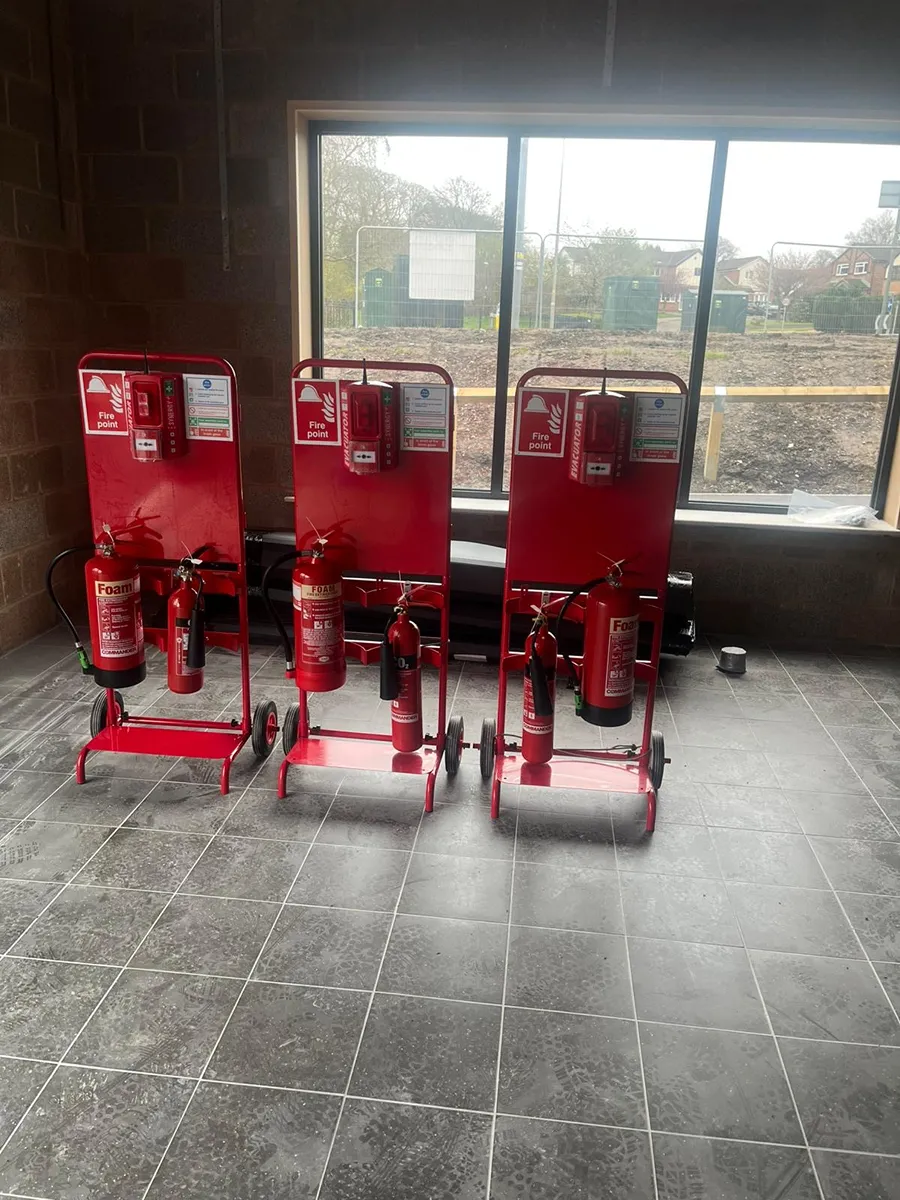
A temporary fire alarm covers the weeks when people are working somewhere without a fire alarm they can rely on. That might be a new build that has not got one yet, a store being refitted with its own system switched off, or a block under cladding work where the building's alarm cannot be heard on the scaffold outside.
We supply battery powered fire alarm points for each of those, anywhere in the UK, from one week upwards. Our five most recent hires ran for between 5 and 34 weeks.
The short answer
- Temporary fire alarm hire puts call points and sounders on a site for as long as the works run, with no mains power or cabling.
- It is used on new builds, on refits where the building's own alarm is isolated or stripped out, and on cladding and scaffold jobs.
- Each unit carries a call point, a foam and a CO2 extinguisher and fire action signage. Radio linked units all sound together.
- The minimum hire is one week, then weekly. Delivery, installation, servicing and collection are included.
What is temporary fire alarm hire?
It is the hire of a self-contained fire alarm for the length of a job. The units run on batteries, need no wiring, go in at the start of the work and come out at the end. Each one is a fire point: a call point to raise the alarm, two extinguishers to tackle a small fire, and signage that tells people what to do.
There are two types. A standalone unit sounds only where its call point is pressed. A radio linked unit is part of a network, so pressing any call point sounds every unit at once. Most jobs need radio linked units, and all five of our most recent hires used them.
When do you need a temporary fire alarm?
Whenever people work somewhere with no fire alarm they can rely on. In practice that is one of the following.
- New build and major construction. From the day work starts until the permanent system is commissioned and handed over.
- Refits and refurbishments. The building's own system is being rewired, replaced or stripped out, or parts of it are out of action while the work goes on.
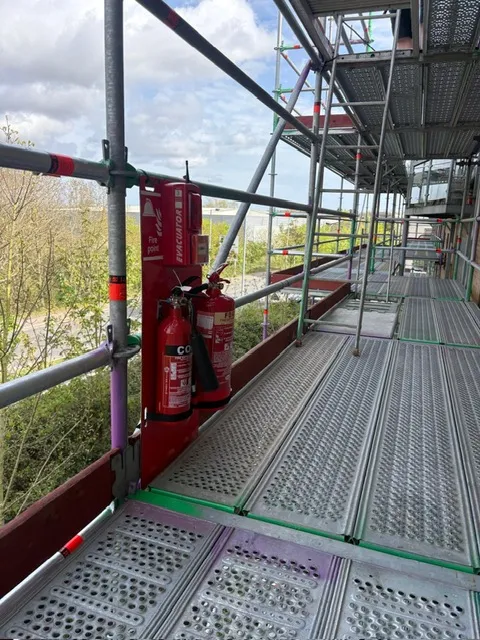
- Cladding, roofing and scaffold work. Even a working building alarm cannot be heard on a wrapped scaffold outside it, and nobody on the scaffold can reach a call point to raise it.
HSE guidance is plain about the second case. HSG168 says to keep an existing alarm working for as long as possible, and "if they are disabled for any reason, provide alternative arrangements." Government guidance for shops and offices accepts gongs or air horns only for a short period while a system is repaired, so for works that run for weeks a temporary alarm is the practical answer.
| Job | Usual units | Why |
|---|---|---|
| New build, ground and upper floors | Radio linked fire trolleys | They roll to wherever work has moved, and every unit sounds |
| Refit or refurbishment | Radio linked fire trolleys | They cover the zones where the building's detection is off and move as zones change |
| Cladding or roofing on a scaffold | Radio linked scaffold post fire points | One on each working lift, heard through sheeting |
| Small job in one open area | Standalone fire trolley | One sounder can be heard everywhere |
How does a temporary fire alarm work during a refit?
It covers the zones where the building's own detection is off and follows the work through the building. Fire trolleys suit refits best, because one person can roll a trolley to the next zone when the work moves on.
Refits rarely need many units. Our supermarket refit in Durham ran on one radio linked trolley for 7 weeks. Refits in Derby and Gloucester took three and five trolleys, for 5 and 11 weeks.
If the building stays open during the works, agree with its responsible person how the temporary alarm and the parts of the permanent system still running work together, and who calls the fire service. HSG168 asks for the alarms in occupied and unoccupied parts of a building to be co-ordinated, so that people outside the work area are warned too. Isolate as little of the permanent system as the work needs, and only while it needs it.
What does a cladding or scaffold job need?
More units, for longer. Our two most recent cladding jobs, in Colchester and Newcastle, each took 20 radio linked fire alarm points, for 34 and 26 weeks. Scaffold post fire points fix to a scaffold tube, so the call point and the extinguishers sit on the lift where people are working.
Wrapped and sheeted scaffolds deaden sound between lifts, so a sounder on one lift may not be heard on the next. Radio linked units get round that: press a call point on any lift and every unit on every level sounds. The rules are covered in fire alarm requirements for scaffolded sites.
How does a temporary fire alarm hire work?
- Send us the job details. The postcode, a start date, a rough idea of how long the work will run, and either a unit count or a floor plan.
- Get a specification and a weekly price. We aim to reply within one business day with the units we recommend, standalone or radio linked.
- Delivery and installation. We deliver anywhere in the UK and install each unit where it is needed, ready to use on day one. Short notice is available.
- Servicing during the hire. We inspect the units on site to keep the extinguishers in date and the alarms working. Add units if the job grows.
- Collection. When the work finishes, we collect everything.
How long can you hire a temporary fire alarm for?
For as long as the job runs. Our minimum hire is one week, and after that hire continues week by week, so a five week refit pays for five weeks. Our five most recent hires ran for 5, 7, 11, 26 and 34 weeks.
Four week minimums are common, and on a short refit that can double the bill. Check the minimum before comparing quotes. Our guide to what temporary fire alarm hire costs lists what else to check.
Who is responsible for the alarm during the hire?
You stay responsible for fire safety. The principal contractor, or the responsible person in a building that stays in use, keeps the fire risk assessment, the fire plan and the weekly alarm test. We are responsible for the equipment: delivered, installed where it is needed and serviced throughout the hire.
HSG168 asks for a weekly test by a nominated person, at the same time each week, with a simple record kept. How to run it, and where units should go, is on our construction site fire alarms page.
Tell us about the building
If the work is in a building that stays open, or where only part of the permanent alarm is switched off, say so when you ask for a quote. It changes where the units go and how many you need.