
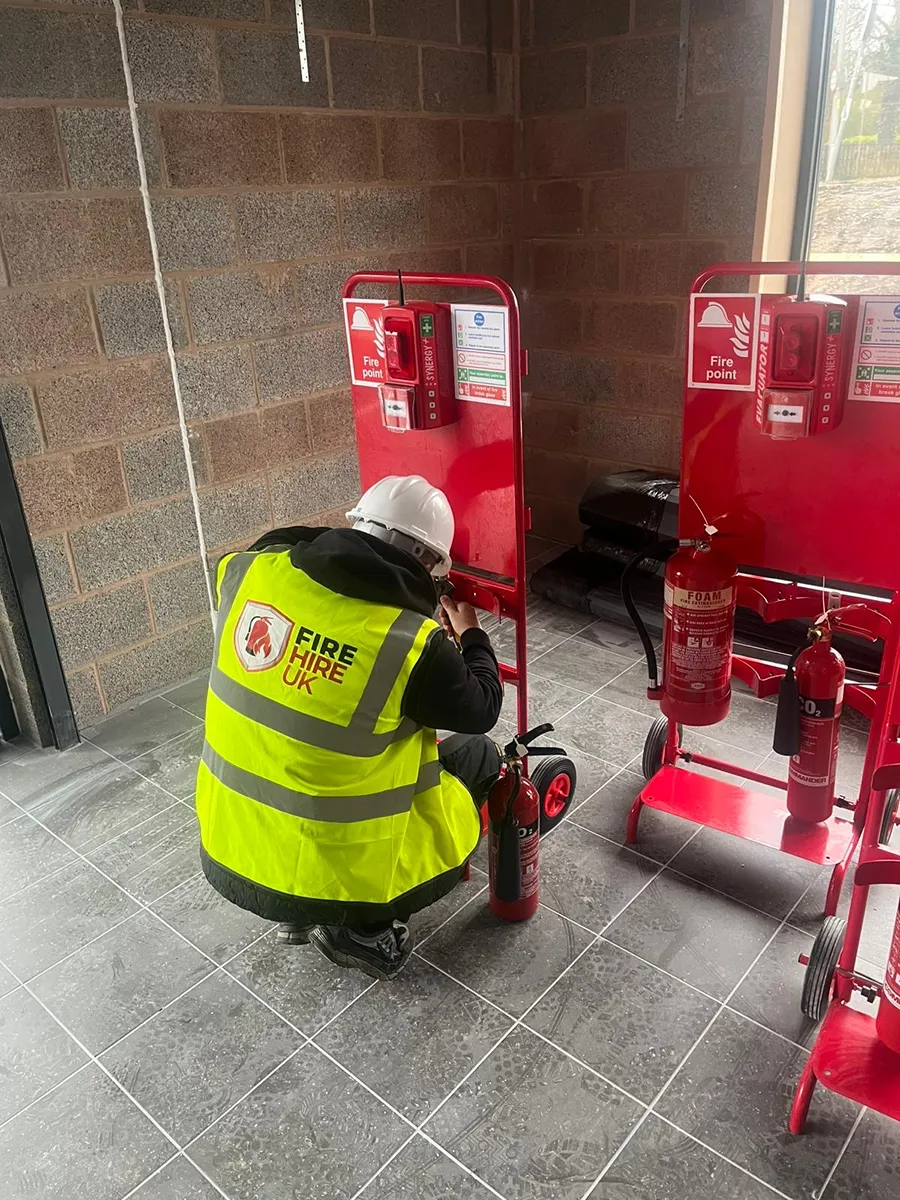
On a construction site an extinguisher is only useful if it is the right type, in the right place, in date, and someone can find it in a hurry. Hiring them on fire points takes care of most of that: the extinguishers arrive mounted on a red trolley or scaffold post board with a call point and signage, and they are serviced for as long as they are on site.
This page explains what we supply, which types a site needs, what the ratings on the label mean, how many to have and how they are looked after during a hire.
The short answer
- Our extinguishers come on fire points: a foam and a CO2 on every fire trolley and scaffold post board, with water, dry powder or wet chemical swapped in where the fire risk assessment calls for them.
- HSG168 treats one 13A water or foam extinguisher and one CO2 extinguisher of at least 1.1 kg per 200 m² as reasonable cover, with both on every floor.
- Use CO2 on live electrical equipment. Foam and water conduct electricity.
- Extinguishers need a basic service every 12 months under BS 5306-3. During a hire, servicing is our job and is included.
- Weekly hire, one week minimum, delivered and installed anywhere in the UK.
How does fire extinguisher hire work on a construction site?
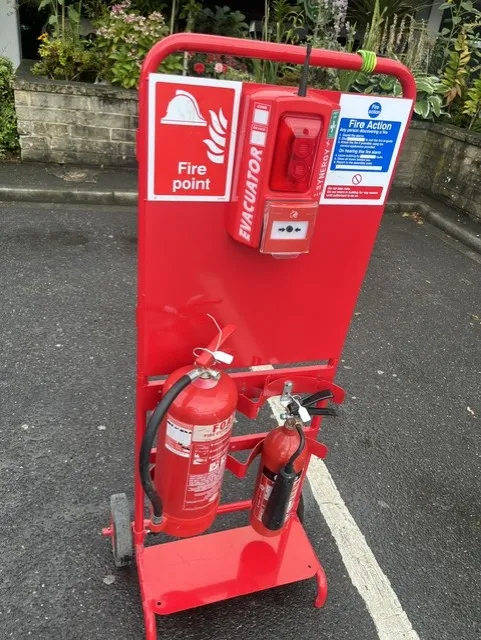
We supply extinguishers on fire points. Each fire trolley and scaffold post fire point carries two, a foam and a CO2 as standard, alongside a break glass call point and fire action signage. We deliver and install them, service them on site during the hire and collect them at the end. Hire is weekly, with a one week minimum.
That arrangement matches what HSE guidance asks for. HSG168 wants extinguishers kept at identified fire points around the site, on hooks or stands to keep them off the ground, and marked by a stand that is substantially red or by a safety sign. A fire trolley or scaffold post board is all three at once, and it moves when the work moves.
Which fire extinguishers does a construction site need?
For most sites, a foam and a CO2 at every fire point. Foam deals with burning timber, packaging, waste and spilt fuel. CO2 deals with electrical equipment, which foam should not be used on. Water, dry powder and wet chemical are for particular risks, and we swap them in when the fire risk assessment asks for them.
| Type | Label colour | Use it on | Do not use it on | Where it goes on site |
|---|---|---|---|---|
| Water | Red only | Wood, paper, textiles and other solids | Flammable liquids, live electrics, metals | Fit out areas with timber and packaging waste |
| Foam | Cream | Solids and flammable liquids | Live electrics, metals, cooking oil | Every fire point, as one half of the standard pair |
| CO2 | Black | Live electrical equipment and flammable liquids | Metals | Every fire point, and beside distribution boards and site offices |
| Dry powder | Blue | Solids, flammable liquids and electrical equipment | Metals, and enclosed spaces where it cuts visibility | Outdoor plant, fuel stores and other open-air risks |
| Wet chemical | Yellow | Cooking oil and fat | Live electrics | Only where a site kitchen cooks with oil |
Two points in that table cause most of the mistakes. First, foam and other water-based extinguishers conduct electricity, so BS 5306-8:2023 says only non-conductive types, such as CO2 or dry powder, should be specified for live electrical equipment. Second, dry powder works on almost anything but HSG168 notes that it does not cool and may reduce visibility, so it suits open-air risks better than corridors and cabins.
Why are foam and CO2 the standard pair?
Because they cover the two fires most likely on a site between them, and they match the HSE benchmark. HSG168 considers one 13A rated water or foam extinguisher and one CO2 extinguisher of at least 1.1 kg per 200 m² of floor area to be a reasonable level of cover, with no fewer than one of each on every floor.
Foam does the job of a water extinguisher on solids and adds flammable liquids, which matter on a site with fuel, solvents and adhesives about. CO2 leaves no residue and does not conduct, so it is the one to reach for at a distribution board or a generator. Each fire point we supply carries one of each, so the HSG168 pair is in place wherever there is a fire point.
What do extinguisher ratings like 13A and 34B mean?
The rating is the size of test fire the extinguisher put out. HSG168 puts it simply: the code printed on the canister "defines the class (or type) and size of fire". The letter is the class of fire and the number is the size, so a higher number means a bigger fire.
- Class A (solids). In the BS EN 3-7 test the fire is a stack of wooden sticks, and the number is its length in decimetres. A 13A extinguisher put out a stack 1.3 metres long.
- Class B (liquids). The number is the litres of liquid in the test tray, one third water and two thirds fuel. A 34B extinguisher put out a 34 litre tray fire.
- Class F (cooking oil). The number is the litres of cooking oil in the test.
Ratings vary by model, so compare them rather than litres or kilograms. These are the ranges printed on current datasheets from five manufacturers:
| Extinguisher | Ratings printed | What that tells you |
|---|---|---|
| 6 litre foam | 13A to 27A, and 144B | Clears the HSG168 13A benchmark on every model checked |
| 9 litre water | 13A to 27A, up to 43A with additive | Solids only, unless the label shows a B rating |
| 2 kg CO2 | 34B on every model checked | No A rating, which is why it is paired with foam |
| 5 kg CO2 | 55B to 89B | For bigger electrical and liquid risks |
| 6 kg dry powder | 27A to 43A, and 144B to 233B | Wide coverage, but it does not cool |
Ratings add up across a floor. BS 5306-8:2023 sets a minimum total Class A rating for each storey: 26A for floors up to 400 m², and 0.065 times the floor area above that. A 600 m² floor needs at least 39A between its extinguishers. Three 13A units only just meet that, and three 21A units clear it with room to spare.
How many fire extinguishers does a site need?
Start with the HSG168 pair for every 200 m² of floor, and at least one of each on every floor. Then check the walking distance. BS 5306-8:2023 keeps the walk to a Class A extinguisher to 30 metres and the walk to cover for flammable liquids or cooking oil to 10 metres, and takes 5 metres off either figure for every door on the way.
Then add cover where the risk is higher:
- Hot works. HSG168 asks for at least two suitable extinguishers within reach of the work and of the fire watch position. The Joint Code wants one of them to be water or foam rated at least 13A.
- Smoking areas. HSG168 says there must be a fire point in the immediate vicinity.
- Bitumen and tar boilers. At least one 9 litre foam or 9 kg dry powder extinguisher close by, and never water.
- Site cabins. Water-based extinguishers for paper and furniture, and CO2 near computers and other large electrical equipment.
- Mobile plant. HSG168 asks for each machine to carry its own suitable extinguisher.
Our guide to how many fire points a site needs works the count through floor by floor.
What about fuel, gas and lithium batteries?
Each needs its own thinking, and none is solved by adding more of the standard pair.
- Fuel and flammable liquids. Foam or dry powder, within 10 metres of the store, and an extinguisher at its entrance.
- LPG and other gases. A gas fire is stopped by shutting off the gas. BS 5306-8:2023 says extinguishers are not normally provided for Class C fires, and where a risk assessment does call for one, it should carry a Class C rating, which in practice means dry powder.
- Lithium-ion batteries. HSG168 says to take competent advice on battery fires. BS 5306-8:2023 accepts a water-based extinguisher for cooling a single small device that is off charge, such as a power tool battery, and nothing more. Charge tool batteries at a proper charging station. The Joint Code keeps e-bikes and e-scooters out of buildings under construction and has them charged in the open, at least 10 metres away.
How are hired extinguishers serviced?
By us, on site, for as long as the hire runs. BS 5306-3 sets a basic service every 12 months by a competent person, an extended service every five years for water, foam and powder extinguishers, and an overhaul every ten years for CO2. HSG168 asks for site extinguishers to be examined at least once a year.
Between services, BS 5306-3 expects whoever is responsible for the premises to look at each extinguisher at least once a month: still in place, undamaged, and not used. On a site, the easiest way is to fold that into the weekly fire alarm test and escape route check. With owned extinguishers all of this is yours to arrange. Our hire vs buying comparison sets out what that adds up to.
What happens if a hired extinguisher is used?
Tell us the same day, even if it was only a short burst. An extinguisher that has been set off cannot be relied on until it has been recharged or replaced, and HSG168 lists telling management whenever an extinguisher is used among the basic site rules.
Ask how a used extinguisher is handled when you get a quote, from us or anyone else, so the answer is known before it matters. Our guide to what temporary fire alarm hire costs covers the other questions worth asking.
An extinguisher is for a small fire
HSG168 describes extinguishers as a way to tackle a fire before it grows, or to help people escape. Raise the alarm first, call the fire and rescue service, and leave if the fire is bigger than the extinguisher.