
A construction site fire alarm has one job. When someone finds a fire, everyone else on site has to hear about it in time to get out. In a finished building the fixed system does that. On a site there is no fixed system yet, the layout changes every few weeks, and the loudest thing on the floor is usually a breaker or a saw.
We hire fire alarm points built for those conditions, standalone and radio linked, to sites anywhere in the UK. This page covers what the law asks for, which type to choose, how many points a site needs and where they go.
The short answer
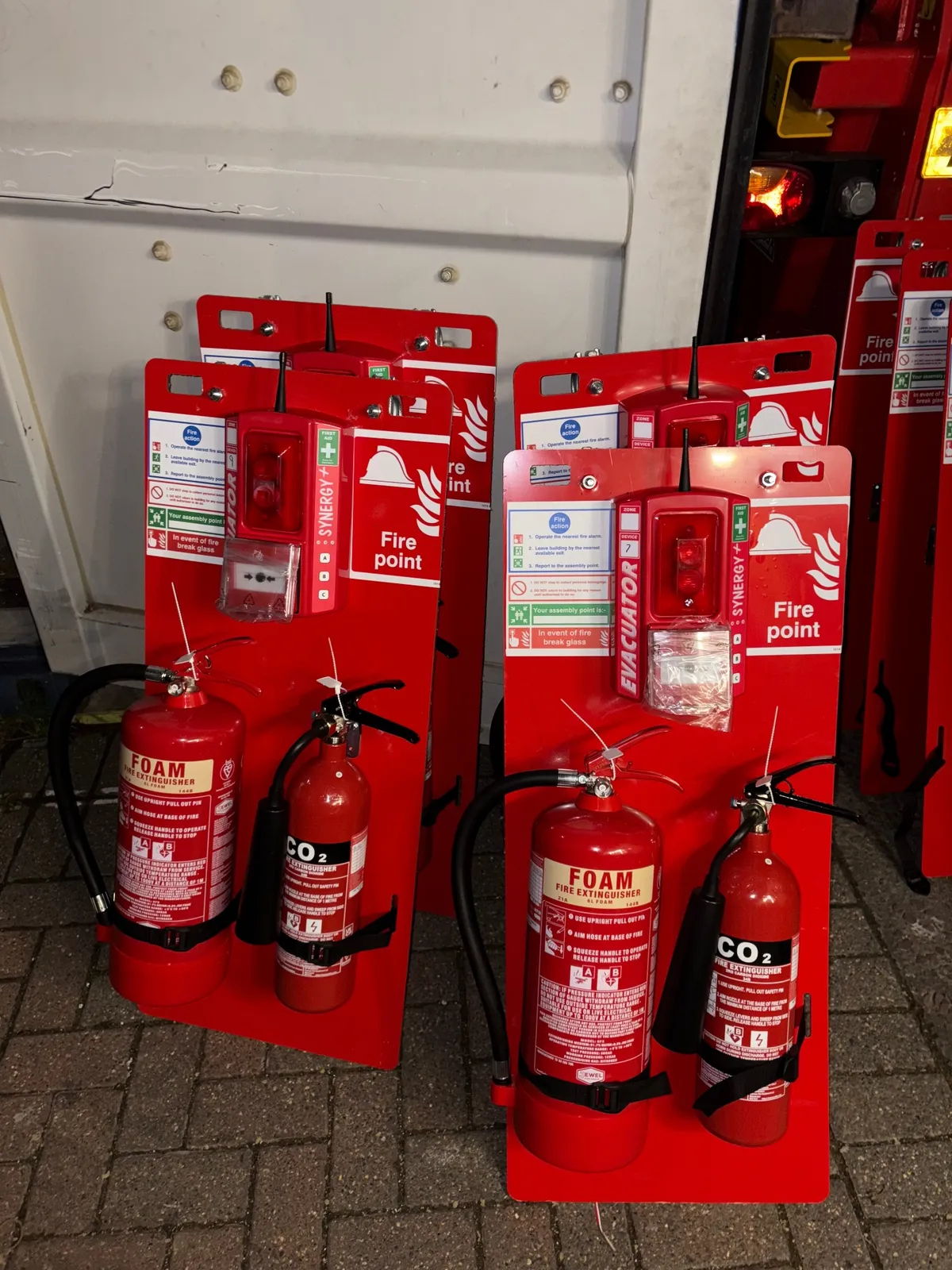
- A site fire alarm is a set of fire points. Ours each carry a break glass call point, a foam and a CO2 extinguisher and fire action signage.
- CDM 2015 regulation 32 requires suitable fire detection and alarm systems wherever they are needed for safety, and HSG168 expects most sites to have an interconnected alarm.
- Radio linked units sound together: press any call point and every unit on site goes off. Standalone units suit only small, open, single level sites.
- Start the count at one fire point per 200 m² of floor, with at least one on every occupied floor and no more than a 30 metre walk to an extinguisher.
- Hire is weekly with a one week minimum. Delivery, installation, servicing and collection are included.
What is a construction site fire alarm?
It is a temporary, battery powered alarm made up of fire points placed around the site. Each point has a break glass call point that sounds the alarm. Ours also carry two extinguishers and fire action signage, so the means to raise the alarm and the means to tackle a small fire are in the same place.
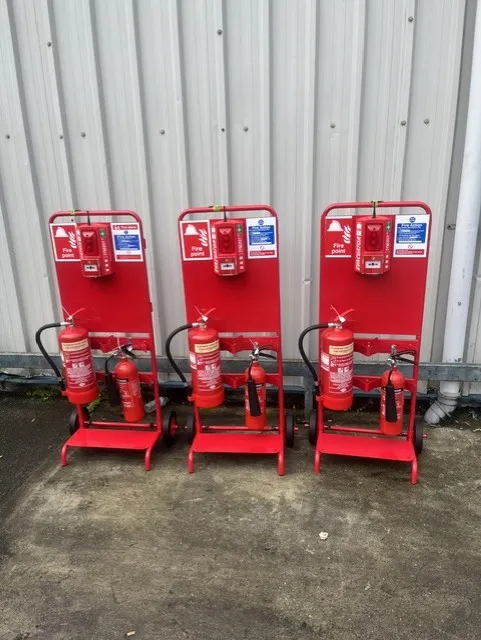
Fire points come in two forms. A fire trolley is a wheeled frame that one person can roll to wherever the work has moved. A scaffold post fire point is a board that fixes to a standard scaffold tube, so the equipment sits on the lift where people are working. Nothing is wired in, so the system can be moved, added to or cut back as the build changes.
Does a construction site legally need a fire alarm?
In practice, yes. Regulation 32 of the Construction (Design and Management) Regulations 2015 says a site must have suitable and sufficient fire-fighting equipment, and fire detection and alarm systems that are suitably located, wherever they are needed to keep people safe. Both have to be examined and tested at suitable intervals and properly maintained.
The regulation does not specify the system. That comes from the site fire risk assessment, which the principal contractor owns, and from HSE guidance. HSG168 expects most construction sites to have an interconnecting system of call points and sounders, wired or wireless. It treats a self-contained alarm as enough only on a limited number of open structures or buildings with a few rooms, and word of mouth only on very small open-air sites.
Fire safety law applies alongside CDM: the Regulatory Reform (Fire Safety) Order 2005 in England and Wales, with equivalents in Scotland and Northern Ireland. Our construction site fire safety guide sets out who holds which duty in each part of the UK.
Standalone or radio linked: which does a site need?
Radio linked, on most sites. A standalone unit sounds only where its call point is pressed. A radio linked unit is part of a network, so pressing any call point sounds every unit on site at once. If one sounder cannot be heard from every place people work, standalone units leave some of them without a warning.
| Question | Standalone | Radio linked |
|---|---|---|
| What sounds when a call point is pressed? | That unit only | Every unit on the network |
| Which sites does it suit? | Small, open, single level sites | Multi storey, scaffolded, spread out or noisy sites |
| Does it work through scaffold sheeting? | Sound is lost between lifts | Every lift hears the alarm |
| What happens as the site grows? | Each new unit is a separate pocket of cover | New units join the same network |
| Does it need mains power or cabling? | No, it runs on batteries | No, it runs on batteries |
The quickest test is to stand where the furthest person works, with the plant running, and ask whether you would hear a sounder at the other end of the site. If the answer is no, or not on every floor, the site needs radio linked units. The full comparison is in standalone vs radio linked fire alarms.
How many fire alarm points does a site need?
Work it out floor by floor. Start with one fire point for every 200 m² of floor area, which matches the HSG168 benchmark of one water or foam and one CO2 extinguisher per 200 m², and give every occupied floor at least one. Then walk the routes. BS 5306-8 keeps the walk to an extinguisher under 30 metres, measured the way a person would actually go.
As an example, take a three storey refurbishment with 600 m² floors, each 40 metres long, with a stair core at each end and a welfare cabin and fuel store in the compound.
| Area | How the count is reached | Fire points |
|---|---|---|
| Each of the three floors | 600 m² ÷ 200 m² = 3 per floor, two by the stair cores and one mid floor, so no walk exceeds 30 metres | 9 |
| Welfare cabin | HSG168 wants every cabin complex to have its own means of raising the alarm | 1 |
| Fuel store in the compound | A higher risk area gets its own cover beside it | 1 |
| Total | Radio linked, because three floors are occupied at once | 11 |
Smoking areas, hot works and LPG storage add to that count, and it should be redone at each phase, because a layout that worked at groundworks rarely works at first fix. Our guide to how many fire points a site needs works through more examples.
Where should fire alarm points go on a site?
On the routes people use to get out, so they pass a fire point on the way. A unit by a stair core or exit lets someone raise the alarm and pick up an extinguisher without walking towards the fire. Spread the rest so the 30 metre walk holds everywhere on the floor.
- At each stair core, exit, and ladder or stair tower access, on every occupied floor.
- On each working scaffold lift, using scaffold post fire points.
- Beside hot works, fuel and LPG stores, and any designated smoking area, which HSG168 says must have a fire point close by.
- In or next to welfare cabins, canteens and drying rooms.
- In plain sight, never behind stacked materials or a locked door.
How often should a site fire alarm be tested?
Every week. HSG168 asks for a weekly test by a nominated, competent person, at the same time each week, with everyone told it is a test and a simple record kept. BS 5839-1 adds a useful habit: use a different call point each week, so that over a few weeks every unit on the network has been proved.
The weekly test is the site's job, because it shows the alarm works on that site that week. The equipment is ours to look after: we service every unit on site during the hire to keep the extinguishers in date and the alarms working. Test again after installation and whenever units are added or moved, since that is when a gap is most likely to open.
How loud does a site fire alarm need to be?
Loud enough to be heard over the site. BS 5839-1 sets the usual benchmark at 65 dB(A), or 5 dB(A) above any noise lasting more than 30 seconds, whichever is higher. Plant on a busy floor can run well above that, which is the strongest argument for radio linked units. Every unit sounds, so nobody depends on one sounder at the far end of the site.
HSG168 asks for a warning that is distinctive, clearly audible above any other noise, and recognised by everyone on site. It singles out noisy areas, lone workers and people whose hearing is affected by ear protection as the cases to plan for. If any of those apply, say so when you ask for a quote and we will put units close to those work areas.
What does construction site fire alarm hire include?
Delivery anywhere in the UK, installation, servicing on site during the hire and collection at the end. Hire is priced per unit, per week, with a one week minimum and weekly after that, so the cost follows the programme rather than a fixed term.
| Unit | What is on it | Best for |
|---|---|---|
| Standalone fire trolley | Foam and CO2 extinguishers, break glass call point, fire action signage | Small, ground level sites where one sounder is heard everywhere |
| Radio linked fire trolley | The same, with a radio linked call point that sounds every unit | Larger sites, with units that move as the layout changes |
| Standalone scaffold post fire point | Foam and CO2 extinguishers, break glass call point, fire action signage | Scaffold and cladding work where a trolley cannot go |
| Radio linked scaffold post fire point | The same, with a radio linked call point | Multi storey and wrapped scaffolds |
Units can be added if the site grows. The full range is on fire point hire, and what sets the weekly figure is explained in what temporary fire alarm hire costs.
Hiring does not move the duty
The principal contractor stays responsible for fire safety on site, including the fire risk assessment, the weekly test and keeping fire points clear. A hire gives you working, serviced equipment in the right places. The duty itself stays with the site.