
Contractors running several projects a year eventually ask whether they should stop hiring wireless fire alarms and just buy a set. It is a reasonable question, and the answer is genuinely not always hire.
The purchase price is the smaller half of the decision. What decides it is the four years of servicing, storage, replacement and record keeping that follow, and whether anyone in your business is actually named against that work.
The short answer
- Hire suits variable demand, which describes most contractors. Cost tracks use, and servicing is the supplier's obligation.
- Buying suits back to back projects of similar size, with compliant storage and a named person responsible for certification.
- Break-even is not the purchase price divided by the weekly rate. Add servicing, storage, transport and replacement, then divide by realistic utilised weeks, not calendar weeks.
- Most contractors who buy do not name anyone against servicing. That is where owned fleets quietly fall out of compliance.
- The middle option beats both for many firms: buy a small core fleet for baseline work, hire the peak.
How do wireless construction site fire alarms work?
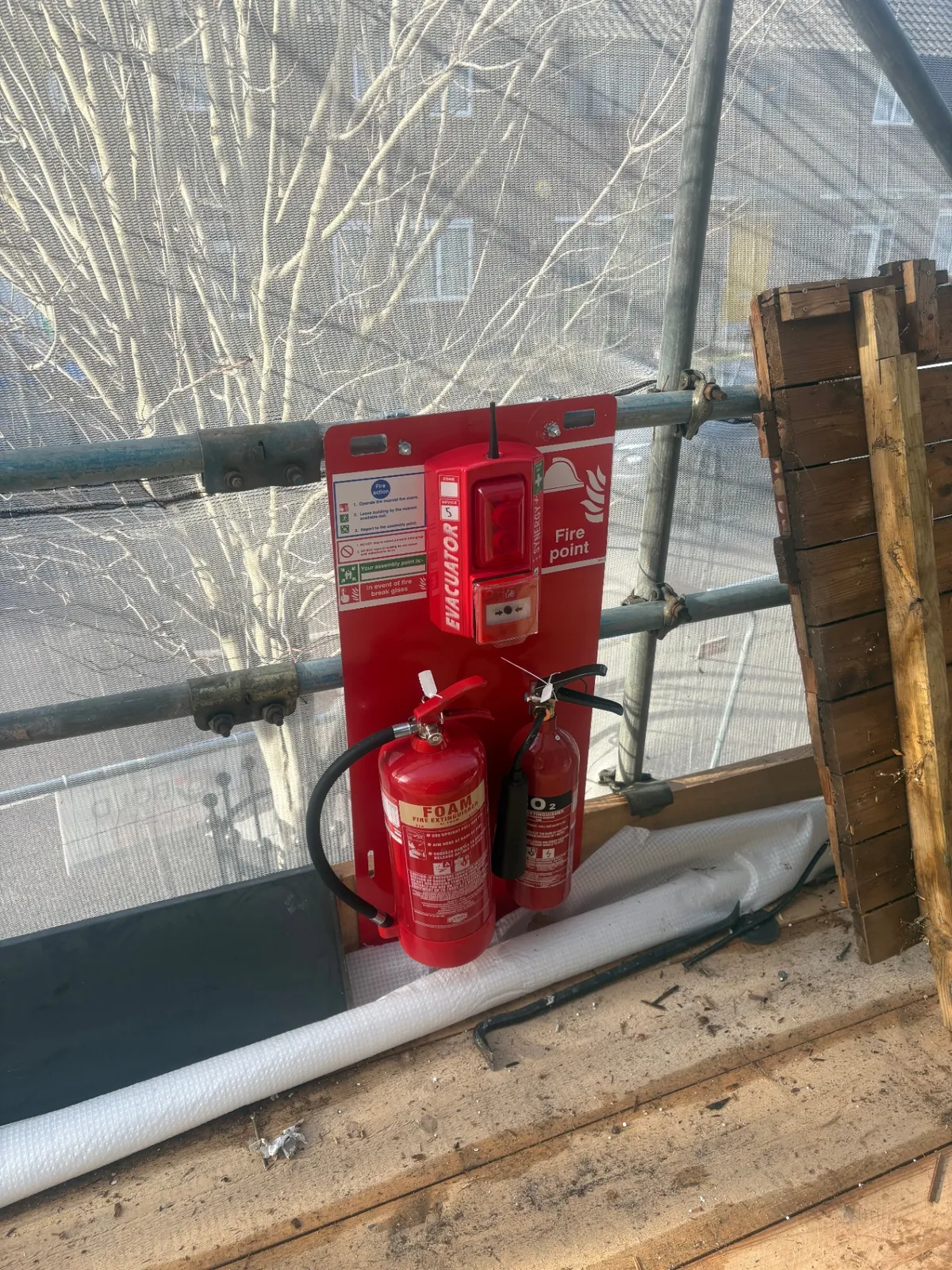
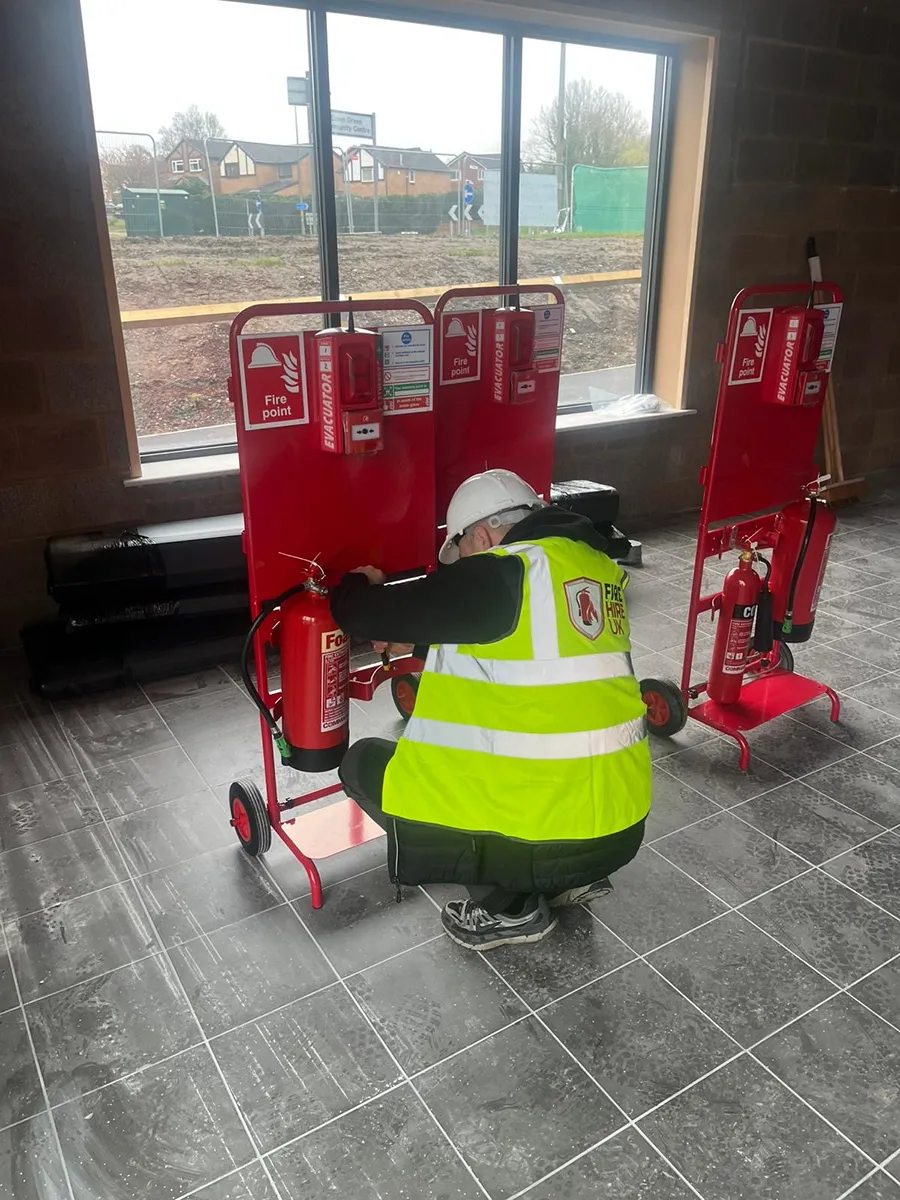
Radio linked units talk to each other over a dedicated radio channel rather than over cabling. Trigger the call point on any unit and every other unit on the network sounds within a second, which is the whole point of them on a site where one sounder cannot cover the working area.
Because they are battery powered and cable free, the units move with the site. That matters more than it sounds. Most construction fire plans fail not because the original design was wrong but because the site changed and the equipment did not move with it. Kit that takes two minutes to reposition actually gets repositioned. How a linked system is planned across a whole site is on our construction site fire alarms page.
What does buying actually commit you to?
- Servicing and certification. Extinguishers need annual service and in date certification. Missing or expired records are among the most common inspection findings, and with owned equipment that record keeping is entirely yours.
- Storage and transport between sites. Including the cost of units sitting idle in a yard between projects, and the labour of moving them.
- Capacity risk in both directions. Buy for your average project and you are short on the big one. Buy for the big one and most of the fleet is idle most of the year.
- Replacement and batteries. Construction sites are hard on equipment. Damage, loss and battery end of life all land on you, and a unit with a flat battery is worse than no unit, because everyone assumes it works.

The three year cost, worked through
Here is the comparison most quotes leave out. Take a ten unit radio linked fleet and run it over three years, and assume the fleet is genuinely deployed for 30 weeks a year, which is a realistic utilisation for a contractor with gaps between projects.
| Cost line | Buying 10 units | Hiring 10 units |
|---|---|---|
| Capital outlay | Paid up front, depreciating from day one | None |
| Annual servicing and certification | Yours to arrange and pay for | Included in the hire |
| Storage between projects | Yard space plus handling | None |
| Transport between sites | Your vehicles and labour | Delivery and collection included |
| Damage, loss and batteries | Your cost, unpredictable | Supplier's cost |
| Idle weeks (22 per year here) | Paid for whether used or not | Not billed |
| Scaling up mid project | Buy more, own them forever | Add units for the weeks needed |
| Admin burden | Named person, records, audit trail | Supplier holds the schedule |
We have deliberately not put pounds in that table, because the honest answer depends on unit count, hire length and how much your idle capital is worth. What the table does show is which lines exist at all, and ownership has six that hire does not. What sets the weekly hire figure, and what should already be inside it, is covered in what temporary fire alarm hire costs.
Where does break-even actually sit?
The naive calculation is purchase price divided by weekly hire rate. That produces a number of weeks that looks reassuringly small, and it is wrong for two reasons.
First, it compares a purchase price against a rate that includes servicing, delivery, collection and replacement. To compare fairly, add your own annual servicing cost, your transport, and a realistic allowance for damage to the ownership side.
Second, it divides by calendar weeks rather than deployed weeks. If the fleet is on site 30 weeks a year, a break-even of 60 weeks is two years of real time, not fourteen months, and by then a proportion of the fleet needs replacing anyway.
The test most people skip
What does hire cover that ownership does not?
A hire agreement should include delivery, installation, servicing during the hire and collection at the end. That last item matters more than it sounds. At the end of a project nobody wants to be arranging collection of fire equipment, and units left on a finished site are units you are still paying for or have simply lost.
Hire also scales mid project. If a site grows, or the layout shifts and travel distances stop working, you add units for the weeks you need them rather than buying more and owning them forever. Our buyer's guide covers how to work out the unit count in the first place.
There is a compliance argument too. With hired equipment the servicing schedule is the supplier's obligation and happens on their calendar. With owned equipment it happens when somebody remembers.
When does buying win?
Buying tends to win when all of the following hold at once:
- You run back to back projects with little idle time between them.
- Your sites are similar enough in size that one fleet fits most of them.
- You already have compliant storage and a named person responsible for servicing records.
- Projects run long enough that cumulative weekly hire exceeds the purchase price once servicing, storage and replacement are included.
If two or three of those are false, hire is usually both cheaper and lower risk. The honest test is the third one. Most contractors who buy do not put a named person against servicing, and that is where owned fleets quietly fall out of compliance.
Is there a middle option?
Yes, and it is what many contractors settle on. Buy a small core fleet for predictable baseline work, and hire the peak.
It caps the idle capital while keeping the ability to scale, and it keeps the owned fleet small enough that servicing it is realistic rather than aspirational. The failure mode of buying, a large fleet nobody maintains, is mostly a function of fleet size.
What changes if the project is worth £2.5m or more?
The Joint Code of Practice on the Protection from Fire of Construction Sites and Buildings Undergoing Renovation applies to projects with a contract value of £2.5 million or more, with additional requirements from £20 million, and insurers on larger projects normally require compliance. Under the Code, extinguishers have to be third-party certificated and serviced every year to BS 5306-3, with the service date marked on each one. Keeping those records stops being administrative tidiness and becomes a condition of your insurance.
That does not rule out ownership. It does mean the record keeping side of the decision carries more weight than the purchase price side. Where the Joint Code sits alongside the law in each part of the UK is set out in our construction site fire safety guide.
What should I compare when getting quotes?
| Ask | Why it matters |
|---|---|
| Are delivery, installation, servicing and collection all included? | These are the lines most often stripped out to make a weekly rate look competitive |
| What is the minimum hire period, and what happens if we overrun? | Overruns are normal in construction. A punitive extension rate is a real cost |
| Can we add or remove units mid hire, and at what notice? | Sites change. A fixed fleet for the whole hire recreates the ownership problem |
| Can extinguisher types be swapped to match our risk assessment? | A fixed pairing that ignores LPG or hot works is a finding waiting to happen |
| How quickly can you get to site if a unit fails? | A dead unit on a live site is a stopped area until it is replaced |
| Who holds the servicing records, and can we get them on demand? | From £2.5m this is an insurance question, not just an HSE one |
What happens at the end of the project?
With hire, collection is the supplier's job and should already be in the price. With ownership, end of project is when the fleet goes back to a yard, batteries slowly flatten, certificates quietly expire, and the next site collects equipment that nobody has checked since the last one.
That gap between projects is where most owned fleets lose compliance. Not through negligence, just through nobody's name being on it.
Whichever way you go, the compliance test does not change. Every worker must be able to raise an alarm, and every worker must be able to hear one. Send us your site plan and we will tell you the unit count either way, including when you need fewer units than you asked for.