The question usually comes up the week the scaffold goes up. Until then the site's alarm covered floors inside a building. Now there are lifts on the outside as well, wrapped in sheeting, reached by a stair tower or a ladder, and often full of people cutting, grinding and fixing cladding.
A scaffold is one of the hardest places on a site to hear an alarm and one of the slowest to get off. HSG168 says so directly: escape via a scaffold is difficult, so rely on it as little as possible. This guide covers what the rules ask for and how we lay out fire points on scaffolds.
The short answer
- No UK regulation names scaffolds. The duty comes from CDM 2015 regulation 32 and the site fire risk assessment, and HSG168 expects most sites to have an interconnected alarm.
- Everyone on a working lift must be able to raise the alarm and hear it. On a sheeted or multi-lift scaffold that means radio linked units on the lifts.
- Put a fire point at the stair tower or ladder access on each working lift, so people pass it on the way out.
- If the scaffold is part of the escape route, HSG168 says its sheeting must be flame retardant, for example to LPS 1215 or TS62, and stair towers stay unsheeted.
- Hot works on a lift need two extinguishers within reach and a fire watch of at least one hour afterwards.
Is there a legal requirement for fire alarms on scaffolding?
Not by name. No UK regulation mentions scaffolds and fire alarms together. The duty comes from regulation 32 of CDM 2015, which requires suitable fire detection and alarm systems on a construction site wherever they are needed for safety, and from the site fire risk assessment, which has to cover the scaffold like any other place people work.
The guidance fills in the detail. HSG168 expects most sites to have an interconnecting system of call points and sounders, wired or wireless, and asks for a warning that is clearly audible above other noise everywhere people work. A scaffold is part of that everywhere.
There is a second layer on blocks of flats. The Fire Safety Act 2021 brought external walls, and anything attached to them, inside the Fire Safety Order, and HSG168 reads that as including scaffolding. The building's responsible person therefore has a stake in the scaffold too, on top of the principal contractor. Who holds which duty across the UK is set out in our construction site fire safety guide.
A scaffold alarm is usually not a fire alarm
Search for a scaffold alarm and most results are intruder alarms, which detect people climbing the scaffold out of hours. They are a security product and warn nobody of a fire. A scaffold fire alarm is a set of call points and sounders on the working lifts.
Why is a scaffold harder to cover than the building?
Because sound, distance and escape all work against you. Sheeting deadens sound between lifts and between the scaffold and the building, so an alarm sounding inside may not be heard on the outside, and the reverse. People on a lift cannot reach a call point inside the building without climbing down or going in through an opening.
Escape is the bigger problem. HSG168 says escape must not depend on throw-out ladders or on rescue by the fire service, prefers proprietary all-metal stair towers, and treats ladder access as a last resort. Every extra second spent getting down is a second that has to come from an earlier warning.
Where should fire alarm points go on a scaffold?
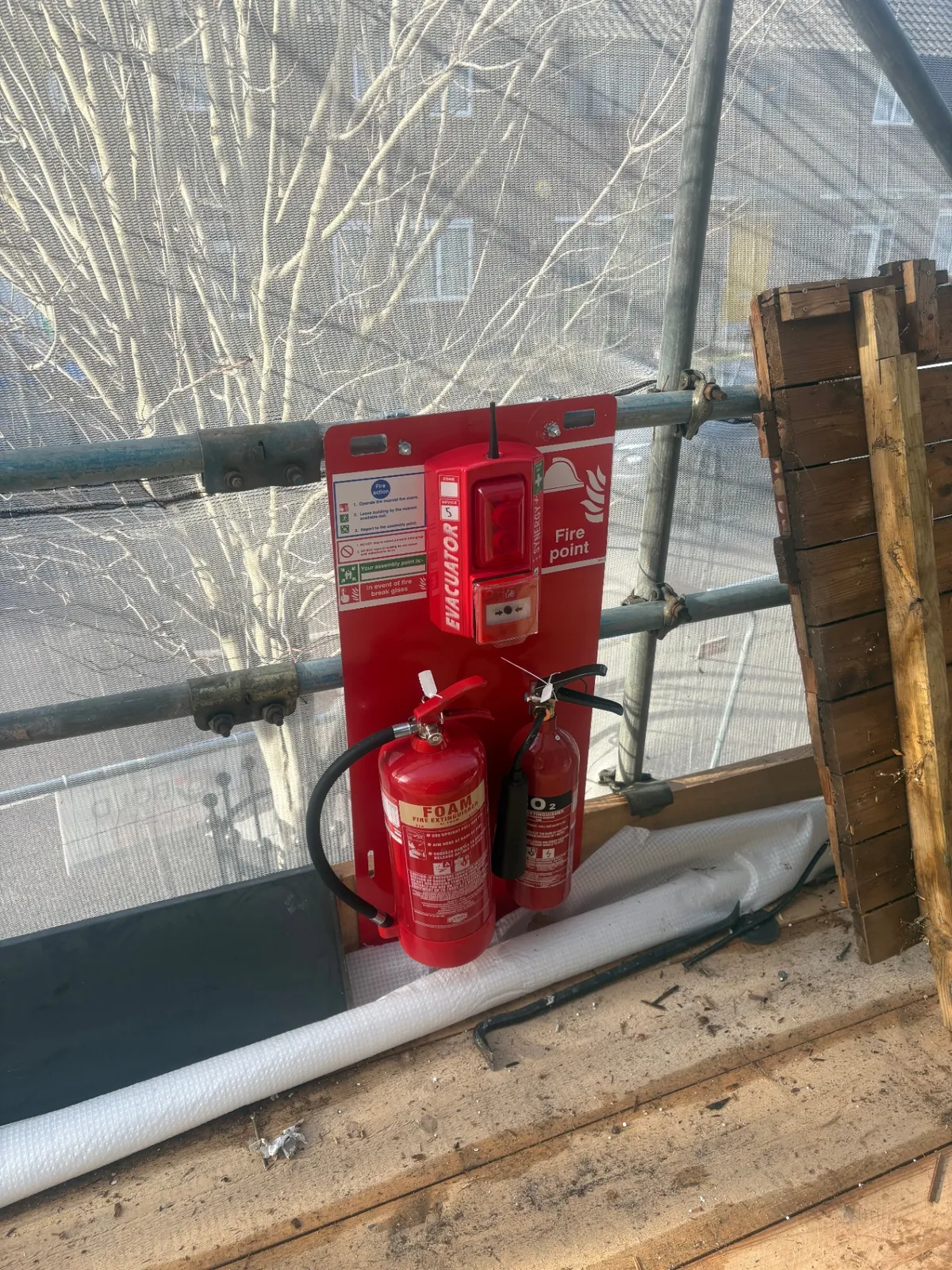
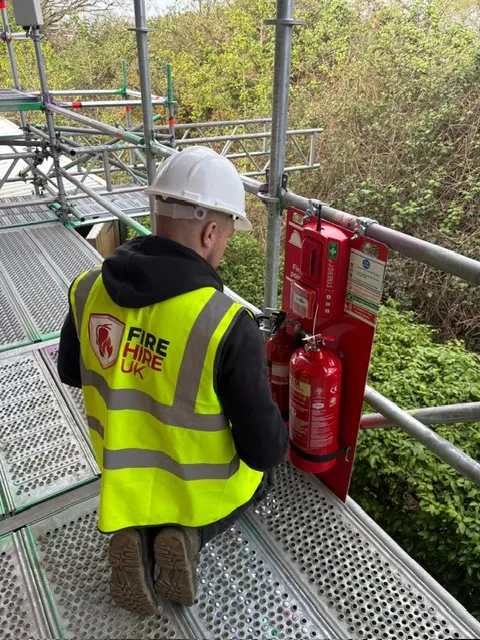
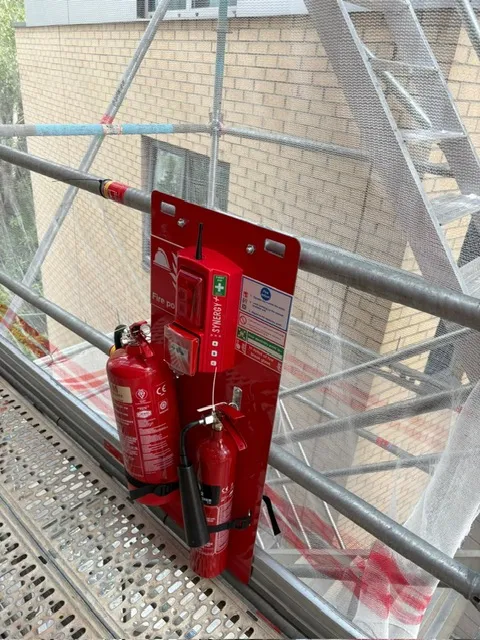
At the access points. A fire point by the stair tower or ladder on each working lift means anyone heading for the way down passes a call point and two extinguishers. On long elevations, add more along the lift so nobody walks more than 30 metres to an extinguisher, the BS 5306-8 limit.
| Location | What goes there | Why |
|---|---|---|
| Stair tower or ladder access, each working lift | Scaffold post fire point with call point and two extinguishers | People pass it on the way out, so nobody walks towards a fire to raise the alarm |
| Along long elevations | Further scaffold post fire points | Keeps the walk to an extinguisher within 30 metres |
| Any lift with hot works | Two extinguishers within reach of the work and the fire watch | HSG168 asks for this wherever hot work is done |
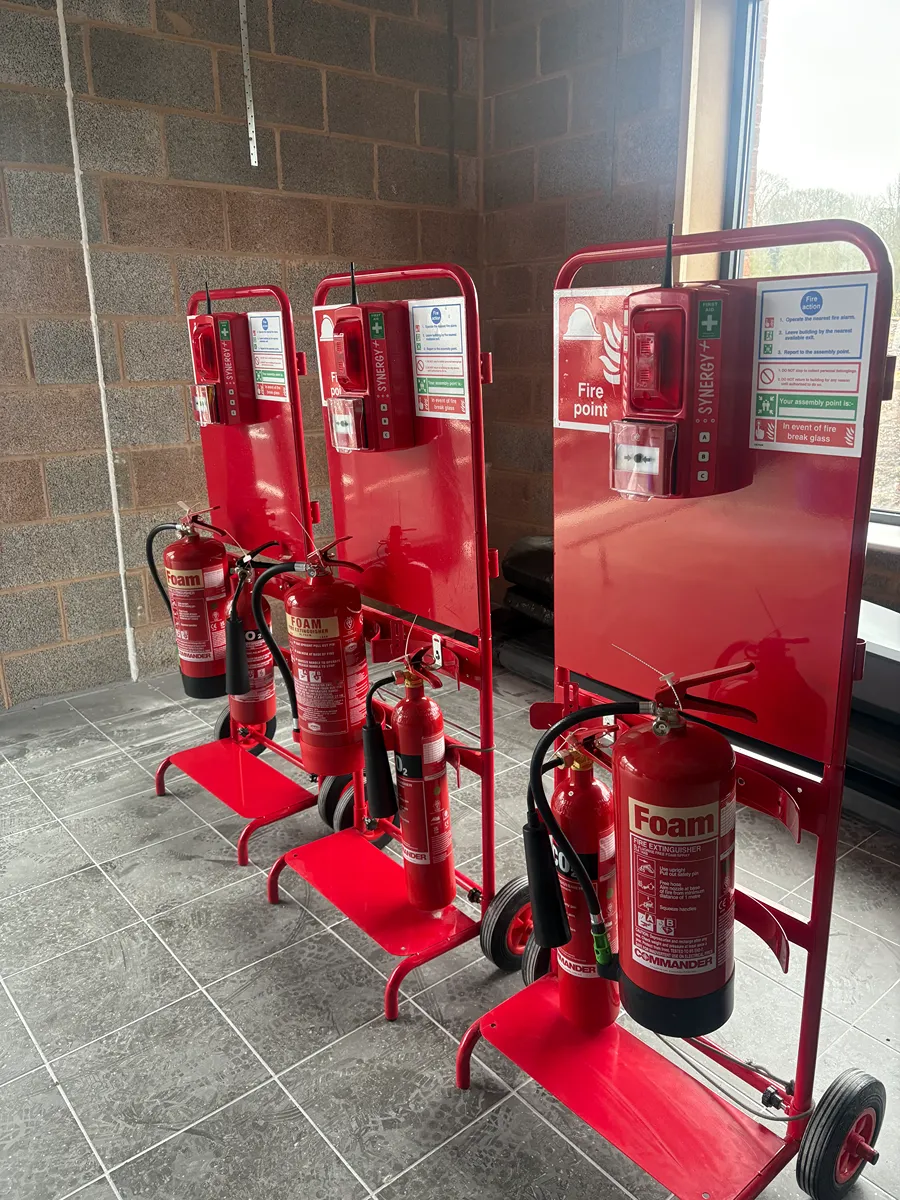
| Foot of the stair tower and the scaffold base | Fire point or fire trolley | Covers the ground level route and anyone arriving at the scaffold |
HSG168 does not ask for one fire point per lift in so many words. In its high-rise section it asks for the alarm to be audible in all areas of the build at all times, and we treat each working lift as a floor. As lifts are added or struck, the fire points move with them.
Do scaffold fire alarms need to be radio linked?
On a sheeted or multi-lift scaffold, almost always. If someone presses a call point on the fourth lift, the people on the first lift, and inside the building, need to hear it too. A standalone unit sounds only where it is pressed, so on a scaffold it leaves most people unwarned.
HSG168 accepts wired or wireless systems, and on a high-rise it adds that radio operated systems can be considered and that the alarm should reach an occupied office from where the fire service can be called. On timber frame it asks for an alarm that warns everyone on site from one activation point. Radio linked units do that without cabling across a structure that changes every week.
Our two most recent cladding jobs, in Colchester and Newcastle, each ran on 20 radio linked fire alarm points, for 34 and 26 weeks. The full comparison is in standalone vs radio linked fire alarms.
What does scaffold sheeting have to be?
Flame retardant, if the scaffold is part of the means of escape. HSG168 says that in that case the sheeting must meet a flame-retardant standard, giving LPS 1215 or an equivalent such as TS62 as examples. It recommends flame-retardant sheeting on structures with exposed timber or flammable insulation and on occupied buildings as well.
- Do not sheet stair towers or escape ladders. HSG168 wants them open, to keep smoke out of the escape route and to make access easier for the fire service.
- Check printed sheeting. HSG168 warns that an image or colour printed on sheeting may affect its flame-retardant performance.
- Remember it still burns. Flame retardant is not fireproof, which is why the Joint Code asks for at least one escape stair to be kept free of coverings.
- On projects under the Joint Code of Practice, scaffold cladding must meet LPS 1215 or TS62, carry a third-party approval mark, and be the approved material throughout, not on some lifts only.
What do hot works on a scaffold need?
A permit, extinguishers at hand and a fire watch afterwards. HSG168 asks for at least two suitable extinguishers within reach of the hot work and of the fire watch position, and the Joint Code wants one of them to be water or foam rated at least 13A. Clear combustible material from beneath the work as well, which on a scaffold means the lifts and boards below.
| Step | HSG168 | Joint Code of Practice |
|---|---|---|
| Fire watch after work stops | Continuous, for at least an hour | Continuous, for at least 60 minutes |
| After that | At least one more check two hours after the work ended | Checks no more than 20 minutes apart, up to 120 minutes |
| Finishing time | All hot work done two hours before the end of the day | End of day fire check, especially where hot work was done |
Two scaffold-specific points. Sheeting is not a welding screen: the Joint Code warns that sparks or molten metal can melt through it. And if a bitumen boiler is used at roof level, HSG168 sets its LPG cylinders at least 3 metres from the burner and says never to use water on a bitumen fire.
How do people escape from a scaffold in a fire?
By a stair tower if at all possible. HSG168 prefers proprietary all-metal system staircases, which can be adapted to any scaffold, and says ladder access should only be a last resort. Where the scaffold is enclosed in sheeting, at least one escape route must be outside the enclosure.
The construction phase plan should say where the scaffold forms part of the means of escape, and the fire points belong on that route. Put the call point where people leave, test it with the weekly alarm test, and move it when the route moves.
What do we supply for scaffolds?
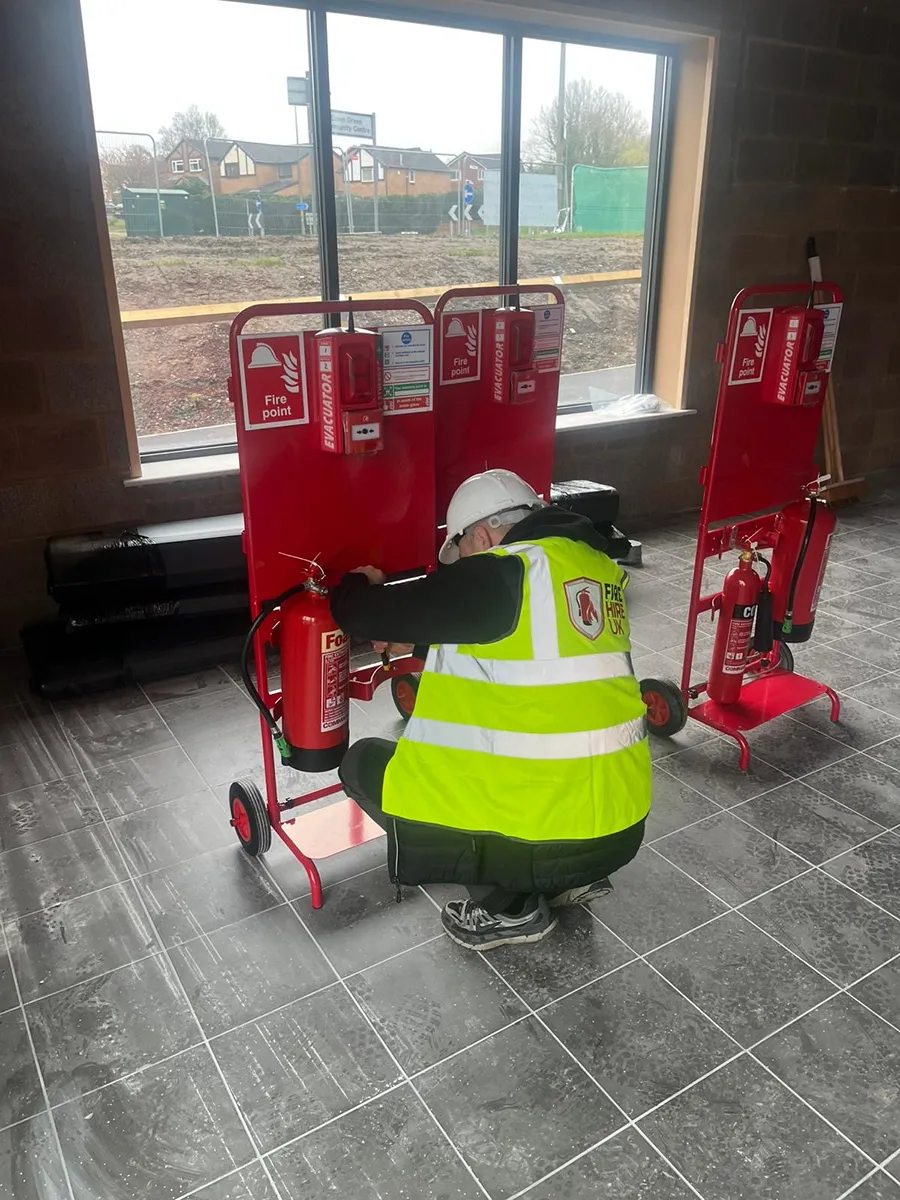
Scaffold post fire points, standalone or radio linked. Each one fixes to a standard scaffold tube and carries a foam and a CO2 extinguisher, a break glass call point and fire action signage. Hire is weekly with a one week minimum, and we deliver, install, service and collect anywhere in the UK.
See the units on fire point hire, how cladding and scaffold jobs run on temporary fire alarm hire, or send us the elevations and the number of lifts and we will work out the count with you.